

Who Is “John” Wahl?
This is one of the most difficult articles I have written.
Not because the facts are unclear or the documentation is weak, but because the people involved live here, work here, and are deeply embedded in the Limestone County community.
The Wahl family is widely regarded as kind, involved, and influential. They hold leadership roles within the local Republican Party, and many people speak warmly of them. I want to be absolutely clear from the outset. This article is not personal. It is not an attack on family members, character, or beliefs.
This is about right and wrong.
This is about transparency, eligibility, and accountability.
And this is about questions that ordinary citizens would never be permitted to avoid.
How This Reporting Began
My observations began in the summer of 2024. What started as curiosity quickly became eye opening and then deeply concerning. Over time, a pattern emerged. City relationships overlapped with county relationships. County relationships overlapped with state party leadership. What initially appeared coincidental began to look systemic.
This made the work that much harder.
Along the way, I met people I respect and formed relationships with individuals who may feel uncomfortable seeing this information laid out publicly. That reality is not lost on me. But discomfort does not negate the public’s right to answers.
The question that surfaced repeatedly was simple but profound.
Who is “John” Wahl?
The Name and the Public Record
Public records indicate that the name “John” Wahl does not appear until voter registration records beginning in 2012. We now know that “John” is not his legal name.
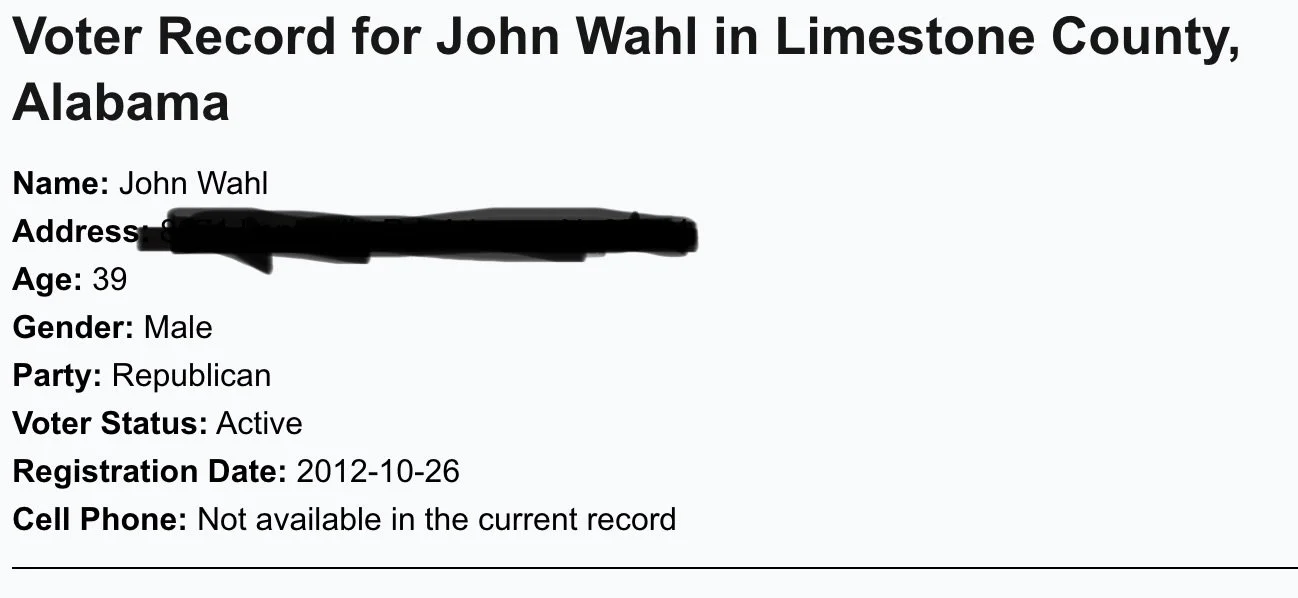
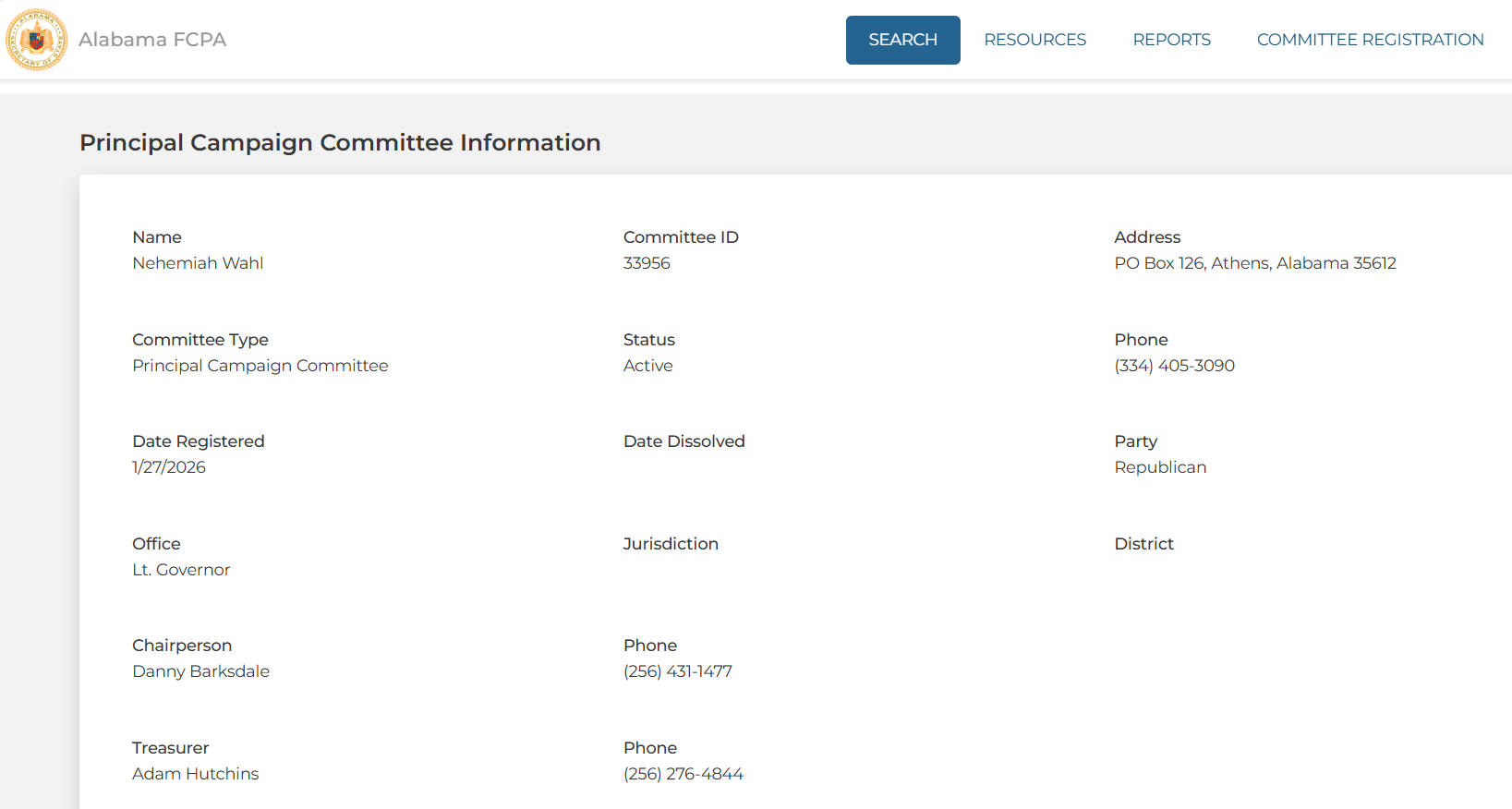
His legal name is Nehemiah Wahl. Not “John.” That is his political alias name. He has even registered his Lt. Governor Campaign under his legal name, Nehemiah Wahl.
Under the name “John” Wahl, he became involved with the Limestone County Republican Executive Committee and rose rapidly through party leadership. He became county chair at a notably young age and later moved into leadership roles within the Alabama Republican Party. In 2021, he became Chairman of the ALGOP, a significant political accomplishment.
Looking backward, however, this rise raises a troubling appearance. Over many years, connections appear to have been cultivated across party structures in ways that later insulated him from internal scrutiny.
When concerns were raised with the ALGOP approximately a year ago, there appeared to be nowhere to turn. At nearly every level, including the State Executive Committee, positions were held by close allies or long standing political connections. If a challenge were formally brought, it is reasonable to ask who would actually vote against their own political network?
This is not an accusation. It is an appearance problem. And appearance matters when public trust is at stake.
Driver Licenses and Voter Registrations
In 2023, Nehemiah Wahl received a speeding ticket and presented a Tennessee driver’s license issued under his legal name.
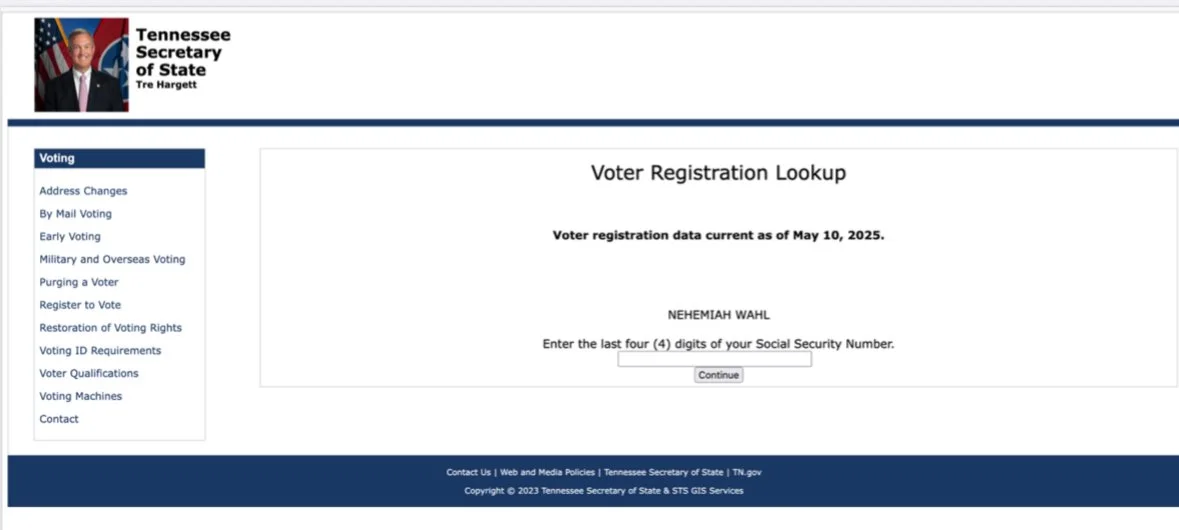
Public voter records later showed that as of May 2025, he was also registered to vote in Tennessee under that same legal name. Within approximately twenty-four hours of that information becoming public, the record was removed. Documentation of its existence was preserved.
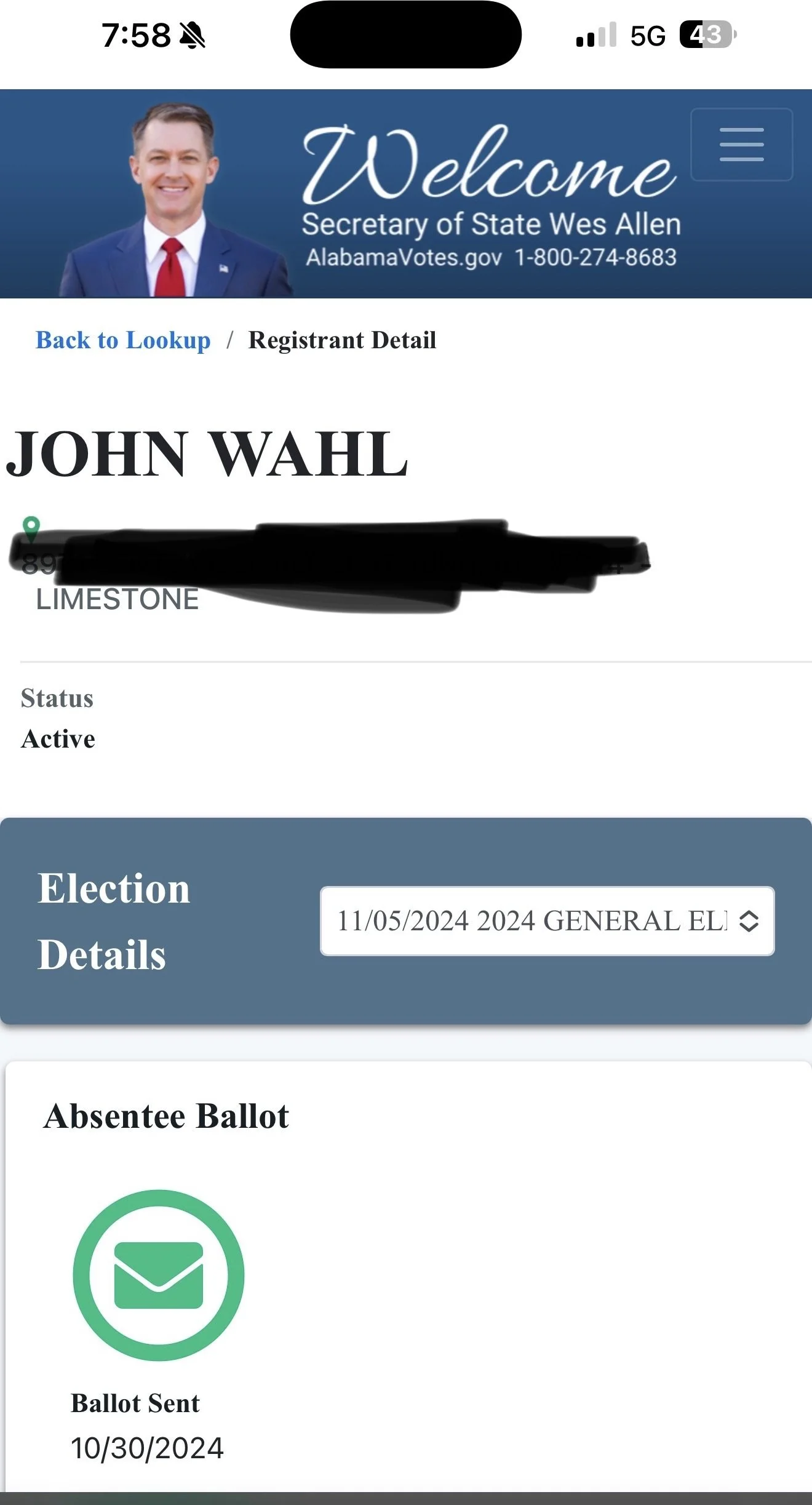
At the same time, Alabama voter records list him under the name John Wahl. Secretary of State website even shows that he cast an absentee ballot in the November 2024 presidential election.
This raises an additional and fundamental question that has not been publicly addressed.
How did Mr. Wahl obtain an Alabama voter registration under a political alias rather than his legal name in the first place?
Voter registration applications are sworn documents submitted under penalty of law. The use of a name that is not a legal name is not a casual clerical preference. It implicates verification procedures administered by the state and overseen by the Alabama Secretary of State.
For an ordinary citizen, holding voter registrations or identification in two states under two different names would raise immediate red flags. For a candidate seeking statewide executive office, it raises serious legal and ethical questions that deserve clear answers.
Mr. Wahl has stated that he does not show his Alabama identification for religious reasons, citing objections to having a digital photograph taken. However, that explanation raises additional questions when compared with the public record. Mr. Wahl has held a Tennessee driver’s license issued under his legal name, which requires a digital photograph, and he has personally posted numerous photographs of himself on social media and at public events, including political gatherings. Taken together, these facts create an inconsistency that has not been explained and further underscore the need for clear and transparent answers regarding identification, documentation, and eligibility.
The Poll Inspector Incident
In 2022, a poll inspector, Mr. Clyde Martin, was terminated after notifying Mr. Wahl in advance that he would need valid Alabama identification to vote and that a media credential could not be used as identification. Mr. Martin stated that the reason given was because he violated Mr. Wahl’s constitutional right to vote.
It is critical to state clearly what did not happen.
Mr. Wahl was never denied the right to vote.
At any time, he could have voted using a provisional ballot without presenting photo identification. That option was available to him throughout the process.
The issue was not access to the ballot. The issue was whether a media credential could substitute for legally required voter identification. Mr. Martin followed the training he received and notified Mr. Wahl of the requirements ahead of time.
Despite this, Mr. Martin was later summoned to a meeting involving the probate judge. Under Alabama election procedures, disciplinary actions of this nature require a properly constituted quorum consisting of specific elected officials.
According to Mr. Martin, that quorum was not present. A deputy stood in place of an elected official, and the required statutory composition was not met.
When the roles of those present and absent are examined more closely, the structure of the meeting raises serious procedural concerns. Combined with the outcome, it creates the appearance that the decision had already been made.
This did not appear to be a spontaneous misunderstanding. It had the hallmarks of a coordinated response.
Why This Matters
Poll inspectors are trained to enforce election rules impartially. When a poll worker is punished for following that training, particularly when the individual involved holds significant political power, it sends a chilling message.
If rules apply selectively, then they do not truly apply at all.
When election integrity mechanisms are overridden by insider influence, public confidence erodes rapidly.
The 2026 Candidacy
On Friday, January 19, 2026, just minutes before the filing deadline, Mr. Wahl announced his candidacy for Lieutenant Governor. This came roughly one day after endorsement from President Trump.
For those who had spent months attempting to raise internal concerns about eligibility and compliance, the timing felt decisive. The questions now become unavoidable.
How does a candidate with a Tennessee driver’s license and recent Tennessee voter registration under his legal name meet Alabama residency requirements under an alias name?
How is it legal to hold identification in two states under two different names?
And how does someone connected to the termination of a poll inspector for asking these questions now seek an office that oversees the systems meant to protect election integrity?
Following the Money and the Network
Reports soon circulated that Mr. Wahl raised more than one million dollars in the first twenty-four hours. A closer look showed that seventy-six thousand dollars came from Athens alone.
The largest local donors mirror the same donor networks that heavily funded establishment candidates in the recent 2025 Athens city municipal elections.
Future articles will examine how closely connected “John” Wahl is to a large majority of local Republican candidates and party officials. That includes financial support, campaign involvement, and the internal party structures that elevate certain candidates while discouraging scrutiny.
One upcoming article will focus specifically on “John” and his role within these networks, examining how relationships and influence shape local races in ways voters rarely see.
Editor’s Note on Voter Registration Requirement
Alabama law requires that voter registration applications be completed using accurate identifying information and submitted under oath.
Under Alabama Code 17 3 4, voter registration applications must be sworn to by the applicant and contain truthful information as required by law. The application is submitted under penalty of law, and the registrant affirms that the information provided is true and correct.
Additionally, Alabama Code 17 17 36 makes it unlawful to knowingly provide false information in connection with voter registration.
These requirements exist to ensure uniformity, verification, and public confidence in the electoral process. They apply equally to all voters, regardless of political position or party affiliation.
This reporting raises a narrow procedural question that has not been publicly addressed.
How did Mr. Wahl obtain an Alabama voter registration under the political alias “John” Wahl rather than his legal name Nehemiah Wahl, given that voter registration requires sworn legal identification.
This article does not assert conclusions or allege intent. It documents publicly available records and asks for clarification regarding the application of voter registration laws overseen by the Alabama Secretary of State.
Transparency in this process is essential to maintaining trust in elections and ensuring that the same standards apply to every citizen.
What Comes Next
The next article will be a one on one interview with the poll inspector.
We will discuss, in his own words, the training he received, the procedures he followed, the meeting that led to his termination, and the personal consequences of enforcing the rules equally.
This is not about politics.
It is about process.
And it is about whether ordinary citizens are protected or punished for doing their jobs.
Editor’s Note
This reporting is not personal. It is based on documented records and unresolved questions that warrant public explanation. All facts cited are drawn from public filings, sworn statements, official procedures, and first-hand accounts tied to those records.
This article does not assert conclusions or assign intent. It presents the paper trail and asks for answers that any ordinary citizen would be expected to provide. Transparency and equal application of the law are essential to public trust, and the questions raised here deserve clear responses.
