
THE LAWSUIT IS OVER. BUT WHO DECIDES IF JOHN WAHL IS CONSTITUTIONALLY QUALIFIED?
Tennessee records document sworn residency declarations, voter registration, licensing activity and a June 2026 license transfer. The court dismissal did not resolve the underlying constitutional question.
By Jarrod Schulte
Disclosure: My wife, Amanda, and I were plaintiffs in the lawsuit challenging John Wahl’s eligibility for lieutenant governor. Readers deserve to know our involvement while reviewing the documents and conclusions presented here. I'm going to be honest. This is a lot to digest, and trying to piece it all together makes my own head hurt sometimes.
What started as questions about John Wahl's residency has turned into something much bigger, raising questions about legal compliance, government records, and accountability. This article brings together what I've uncovered so far. I'll break it down section by section, and as we submit additional records requests and receive more documentation, we'll take deeper dives into the individual issues. Because at this point, the questions go well beyond residency, and there are still plenty of answers we intend to pursue.
On October 13, 2026, the Montgomery County lawsuit challenging Republican lieutenant governor nominee John Wahl’s residency ended. But an important distinction remains: the lawsuit was dismissed; a court did not determine whether Wahl satisfied the constitutional residency requirement.
The court granted the plaintiffs’ stipulation of dismissal with prejudice. The dismissal did not decide the underlying facts of Wahl’s domicile or resolve the jurisdictional arguments in that case. Separately, the Alabama Supreme Court had ruled that a particular quo warranto challenge to a political party nominee could not proceed before that nominee assumed office.
If judicial review remains unavailable before Election Day, who ultimately determines whether a candidate meets Alabama’s constitutional qualifications? And who examines the evidence before voters receive a definitive answer?
It is important to remember that the original challenge, filed at the end of January 2026, concerned Wahl’s eligibility for the Republican nomination, not his eligibility in the November general election. On February 1st, the Alabama Republican Party Steering Committee split 9–9 on whether to hear that challenge. Acting Chairwoman Joan Reynolds cast the deciding vote against moving forward, meaning the challenge was dismissed without a formal hearing.
Questions were also raised about potential conflicts of interest among committee members, including allegations that at least three individuals who voted in Wahl’s favor should have recused themselves because of conflicts of interest.
That was more than eight months ago, before the additional evidence now being presented publicly. The committee never conducted a full hearing on the original challenge, much less examined the complete body of evidence available today.
So the question remains: Who will review all of the evidence and make a determination about Wahl’s constitutional eligibility before November 3rd?
This Was Never Simply About Owning Two Houses
This dispute does not turn on how many properties Wahl owns or whether he spent particular nights in Alabama or Tennessee. Legal domicile can exist in a rented home, a family residence or other dwelling, and property ownership is not required.
Article V, Section 117 of the Alabama Constitution requires a lieutenant governor to have been a resident citizen of Alabama for seven years immediately before election. For November 3, 2026, the period begins November 3, 2019. The central question is whether Wahl continuously maintained Alabama legal domicile during that period.
The Documentary Timeline
Date Recorded event
October 26, 2012 Alabama voter record lists John Wahl in Limestone County
November 17, 2020 Tennessee driving history lists original issuance date
November 18, 2020 TN voter application declares TN legal residence
December 2, 2020 Tennessee license application lists existing Class PD credential
December 2, 2020 Notarized affidavit identifies a Tennessee legal residence
June 24, 2026 Tennessee driving record notes a license transfer to Alabama
**These are licensing and registration dates, not a court-verified timeline of changes in legal domicile. In particular, a license transfer in June 2026 is not equivalent to a legal determination that Alabama domicile began in June 2026.
First a Tennessee Permit. Then a Tennessee Driver’s License.
The signed December 2, 2020, application identifies Nehemiah Ezekiel Wahl, lists a Tennessee residential address, and indicates that he already held a Tennessee Class PD credential consistent with a learner’s permit. Wahl marked YES to Tennessee driving credentials and NO to holding a driver’s license, permit or ID from another state. The official driving history also lists a subsequent Class D license.
That does not prove he had never held identification in Alabama. It documents his answer on that date. The complete Alabama licensing record and Tennessee identification documents used during the application process remain important outstanding evidence. But it should be noted that if he had a learners permit in another state Tennessee would have accepted it.
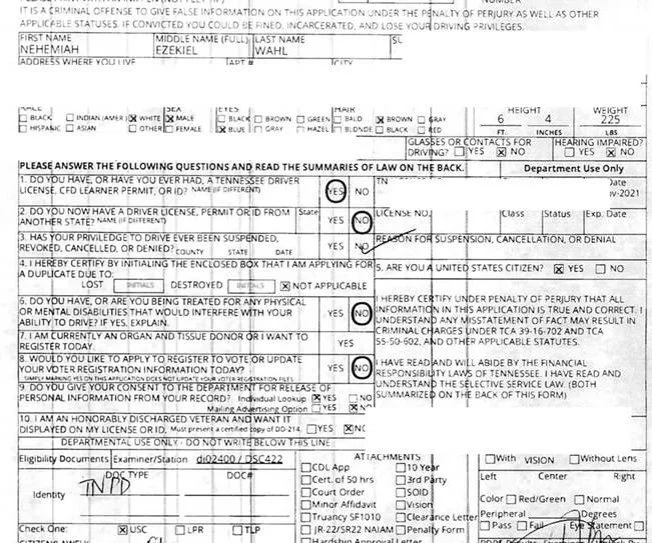
EXHIBIT 1 · Tennessee application (December 2, 2020); private identifiers redacted.
Another Question: The Eight-Digit Alabama License
According to the Alabama Law Enforcement Agency, the state did not begin issuing eight-digit driver's license numbers until December 1, 2018. Existing seven-digit license holders retained their numbers. Wahl's current Alabama driver's license reportedly has eight digits. If Wahl previously held an Alabama license before 2018, why does his current license have an eight-digit number?
Does that mean his first Alabama driving credential was issued after the numbering change, or was a new number assigned when his Tennessee license was transferred in June 2026? The number alone cannot answer that question. But his original Alabama license issuance date can. And that is another official record worth examining alongside his Tennessee licensing history.
The Sworn Tennessee Legal-Residence Affidavit
A Social Security Number Affidavit signed and notarized December 2, 2020, identifies a Five Points, Tennessee, address in its “LEGAL RESIDENCE” field. The affidavit also states that no Social Security number had been issued to the applicant. The form served a licensing-documentation purpose, not an adjudication of election domicile. Nonetheless, its express legal-residence statement is relevant to Wahl’s claim that Alabama domicile continued uninterrupted.
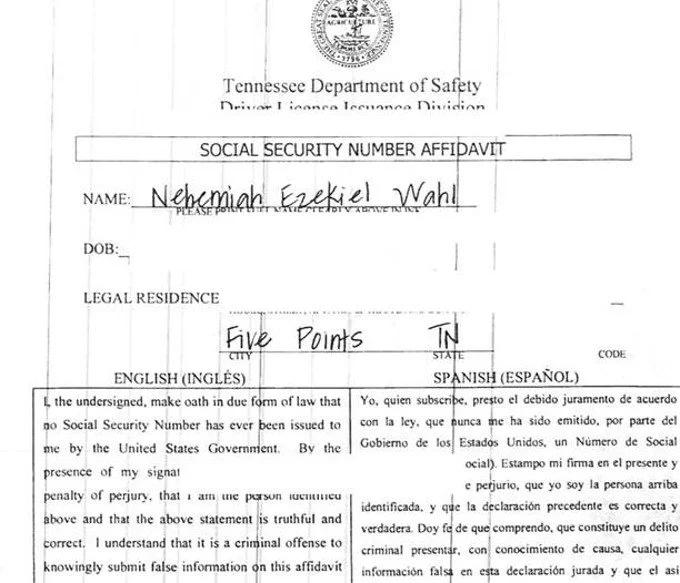
EXHIBIT 2 · Tennessee notarized affidavit, with residential street address and private identifiers obscured.
One Man, Two Names and Two Voter-Registration Systems
A Tennessee voter-registration application dated November 18, 2020, is signed under the name Nehemiah Wahl. It marks YES to Tennessee residency and declares that the listed address is the applicant’s legal residence, where he intends to remain for an undetermined period.
The previous-registration area also includes the words “First Time To Register.” That makes it uncertain whether the phrase refers to a first Tennessee registration or a first registration anywhere.
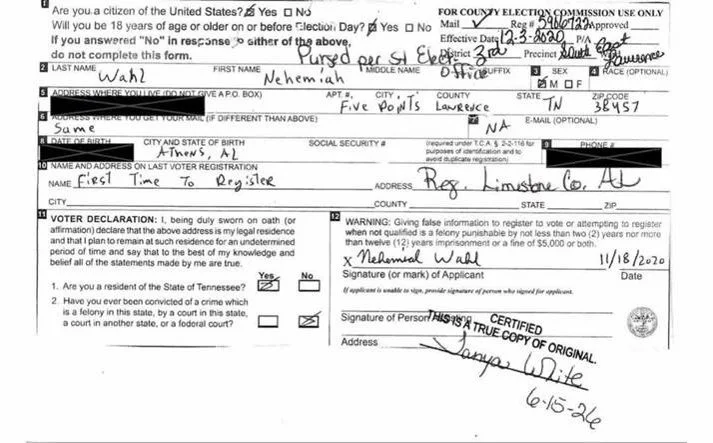
EXHIBIT 3 · Tennessee voter-registration application (November 18, 2020), as supplied with personal fields obscured.
An Alabama voter record lists John Wahl as registered in Limestone County on October 26, 2012, and active when that record was viewed. A separate Alabama lookup lists John Wahl as active and shows a 2024 absentee ballot “Sent” on October 30, 2024. A Tennessee lookup dated May 10, 2025 displays Nehemiah Wahl.
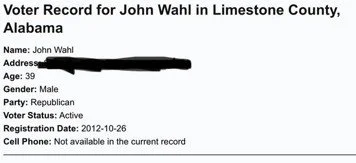
EXHIBIT 4 · Alabama registration history, with address redacted.
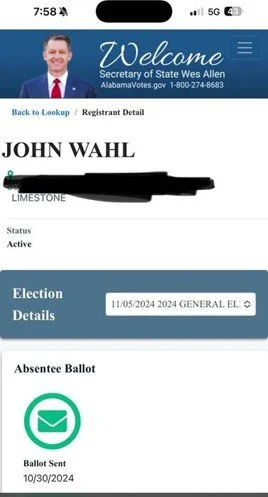
EXHIBIT 5 · Alabama absentee-ballot status, showing “Ballot Sent,” not returned or counted
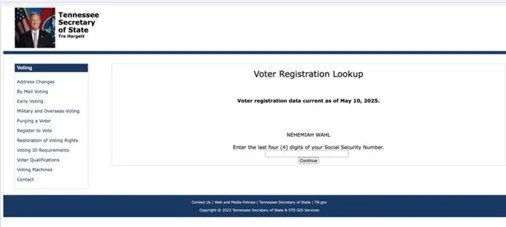
EXHIBIT 6 · Tennessee voter-lookup screen (data current May 10, 2025). No active-registration determination is visible on this screen
An Updated Alabama Registration and a Limestone County Parcel-Viewer Image
A newer Alabama Secretary of State voter-lookup screenshot lists “Nehemiah Ezekiel John Wahl” as an active registrant in Limestone County. The earlier screenshots identified “John Wahl.” The newer screen also shows an Elkmont address, but it does not establish when the name or address was changed, who requested the update, or what documentation supported it
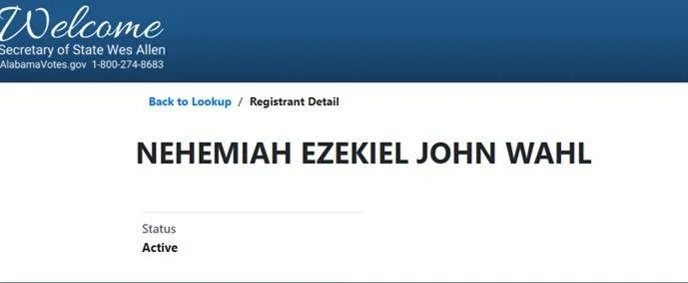
EXHIBIT 7 · Updated Alabama voter lookup showing full displayed name and active status. Residential address redacted.
The address shown on Wahl’s updated Alabama voter-registration screenshot matches the address of the parcel displayed in the Limestone County Alabama Parcel Viewer. The county parcel record contains a photograph of a manufactured home and identifies owners other than Wahl. This is a direct match between the reported voter-registration address and the parcel address; it is not, on its own, proof of when he began living there, whether he rents or otherwise occupies the home, or whether he owns property elsewhere. A person can legally reside in a home they do not own.
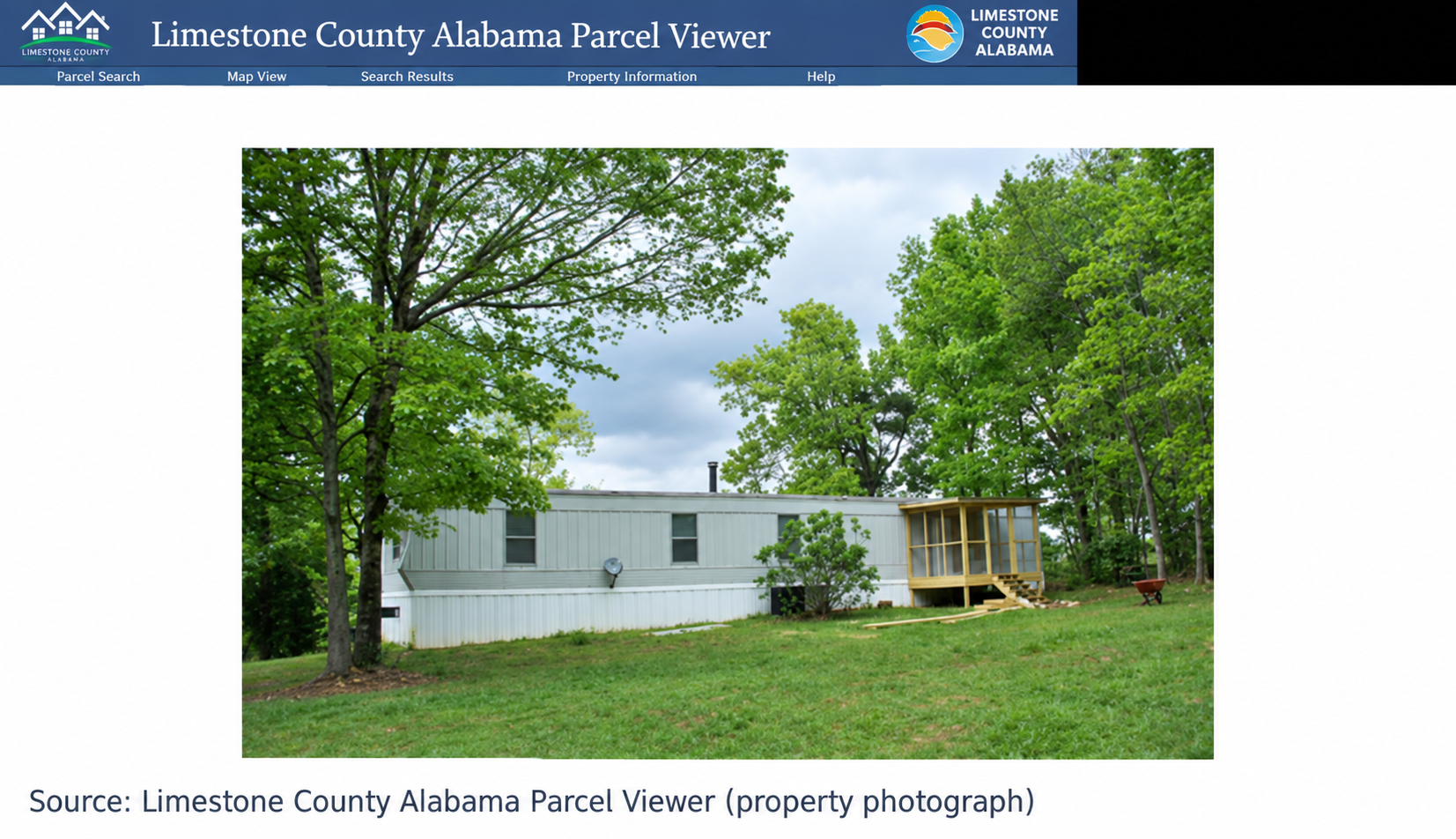
EXHIBIT 8 · Manufactured-home photograph from the Limestone County Alabama Parcel Viewer for the address matching the updated voter registration. Exact address, owners’ names, parcel identifiers, and pinpoint map location redacted.
The useful follow-up is a dated audit trail from the Alabama Board of Registrars: When were the name and residence fields updated, and what records supported those changes? The screenshots alone cannot establish a legal change of domicile or show that any registration was improper.
The different names alone do not demonstrate wrongdoing: both names have been associated with the same individual. Questions for election authorities include whether Tennessee notified Alabama, whether an interstate match occurred, the date of any cancellation and what happened to the Alabama absentee ballot.
Religious Photo Exemption and Public Photography
In a handwritten statement accompanying the Tennessee documents, Wahl described a sincerely held religious objection to certain uses of photography, referencing Anabaptist denominations. Some Anabaptist traditions have historically emphasized separation between church and government, although views on political participation and photography vary.
Yet Wahl maintains a highly visible political and personal presence on social media, regularly sharing photographs documenting his campaigns, public appearances, and personal life. His image is routinely used to promote his candidacy and attempt to connect with voters.
While sharing photographs publicly does not automatically contradict a religious objection to photographic government identification, it raises a reasonable question: What specifically makes a photograph objectionable when used to identify Wahl on a government-issued document, yet acceptable when voluntarily used to promote himself politically?
The issue is not whether Wahl has the right to his religious beliefs. He absolutely does. The question is how he distinguishes between these uses of his image, what accommodation he actually requested, and whether the same standards would apply to any other citizen.
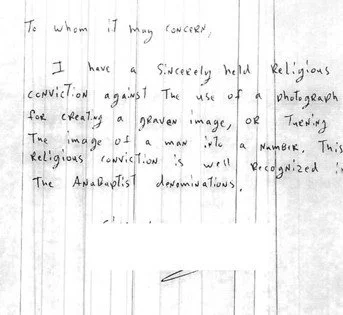
EXHIBIT 7 · Handwritten religious photo-exemption statement, redacted.
The Poll Inspector Who Questioned Wahl's Identification
The questions surrounding Wahl's identification are not new. In 2022, Limestone County poll inspector Clyde Martin was removed from his position following a dispute over the identification Wahl presented to vote. Martin questioned whether the identification satisfied Alabama's voter ID requirements, while Wahl maintained that it had been approved by the county probate judge.
The incident attracted media attention and raised questions about how voter identification rules were interpreted and enforced.
We previously interviewed Martin about his experience, and this history warrants another look alongside the licensing and identification records now coming to light.
June 24, 2026: The Date That Deserves Attention
The certified Tennessee driving history contains a significant entry: June 24, 2026 license transferred from Tennessee to Alabama.
Look closely at that date.
● AFTER Wahl qualified to run for lieutenant governor.
● AFTER the Alabama Republican Party dismissed the original residency challenge in February.
● AFTER Alabama's May 19th Republican primary.
● AFTER the June 16th Republican primary runoff.
Only after all four milestones does the Tennessee driving record document the transfer of his license to Alabama.
This was not years before his candidacy. It was June 24, 2026, just over four months before the general election.
A driver's license transfer does not, by itself, establish when someone changed legal domicile. Wahl maintains that he never abandoned his Alabama residency.
But the timing raises an important question: If Wahl continuously maintained Alabama as his legal domicile, how does he explain a Tennessee-to-Alabama license transfer occurring only after qualification, the original residency challenge, the primary, and the runoff?
The constitutional requirement concerns seven years of residency immediately preceding the November 3, 2026 election. The public deserves an explanation that reconciles the sworn Tennessee declarations from 2020, the subsequent licensing history, and Wahl's claim of continuous Alabama domicile.

EXHIBIT 10 · Certified Tennessee driving-history entry: transfer dated June 24, 2026.
Two States. Two License Records. One Unanswered Question.
The certified Tennessee driving history records a transfer from Tennessee to Alabama on June 24, 2026. Yet court records cited in September reporting indicate Wahl presented an Alabama driver's license during a June 2025 traffic stop, a full year earlier.
That creates a question extending beyond the constitutional residency debate. If Wahl already possessed an Alabama driver's license in 2025, why does Tennessee's certified driving history record a transfer to Alabama in June 2026?
Alabama and Tennessee both have licensing requirements designed to prevent individuals from maintaining multiple valid driver's licenses. These records do not establish that Wahl violated those requirements. But they do warrant a clear explanation of when each license was issued, when each was valid, and when Tennessee officially recognized the transfer.
The question is no longer limited to where Wahl claimed legal residency. It also concerns whether the official licensing records from two states can be reconciled.
That is a question the issuing agencies should be able to answer.
The Case Ended. Who Decides the Constitutional Question?
Wahl maintains that he never abandoned Alabama domicile. His defense has pointed to Alabama ties and argued that a Tennessee license or voter registration does not itself displace established domicile. Alabama domicile law looks to a person’s home and intention, and a previous domicile ordinarily continues until a new one is acquired. The October 2026 lawsuit ended without findings on those disputed facts. That result neither proved the plaintiffs’ allegations nor determined that Wahl met the seven-year requirement. Candidate eligibility may be subject to party-contest procedures, particular election deadlines and properly authorized judicial challenges. The scope and timing of any remaining challenge would require legal review.
What did the party or election authorities review when Wahl qualified?
Were the Tennessee licensing and registration documents part of that review?
What additional Alabama residency records were considered?
And which institution, using which lawful process, can resolve the disagreement on the merits?
A dismissed lawsuit and a finding of constitutional eligibility are two different things. The Tennessee paper trail remains, and the public still lacks a reported judicial finding about whether Wahl maintained the required domicile during the full seven years.
Two Homes. Two States. But Only One Legal Domicile.
John Wahl keeps reminding everyone that a person can have more than one home.
He's right. But that's never been the question.
In November 2020, Wahl signed a Tennessee voter-registration application declaring Tennessee his legal residence.
In December 2020, he signed a notarized affidavit identifying Tennessee as his legal residence and obtained Tennessee driving credentials.
And this wasn't just paperwork from 2020.
In April 2023, Wahl was stopped for speeding in Alabama, presented a Tennessee driver's license, and had a Tennessee address recorded on the citation.
Then, on June 24, 2026, Tennessee recorded the transfer of his driver's license to Alabama.
2020: Tennessee residency declarations.
2023: Tennessee identification presented in Alabama.
2026: Tennessee license transferred to Alabama.
Yet Wahl maintains he never abandoned Alabama domicile.
These records do not conclusively establish where he was legally domiciled, but they raise questions that deserve answers. If Tennessee was his legal domicile, how did he satisfy Alabama's seven-year constitutional residency requirement?
If Alabama was always his domicile, how does he explain the sworn Tennessee residency declarations?
And if any declarations were knowingly false, should the responsible authorities investigate whether laws were violated?
The Montgomery lawsuit ended without deciding those questions.
You can have two homes. But sworn statements to two state governments still have legal significance.
For us, this was never just about John Wahl. This is about the very reason we started The Limestone Lowdown in the first place: expecting the same laws and standards to apply to everyone, regardless of their name, position, or political connections.
And yes, this one hits close to home. Wahl is from Limestone County, and his family has longstanding ties to leadership within the Limestone County Republican Executive Committee. These aren't distant political figures in Montgomery. These are people connected to the very community where we live, work, and raise our children. Of course this hasn't been easy for us.
But asking questions about people in positions of influence shouldn't come at a different price simply because you live in the same community. We never started The Limestone Lowdown because we wanted to take on political figures or find ourselves in courtrooms. We started it because we believed our community deserved transparency, fairness, and accountability. That hasn't changed.
This was never about holding one person to a higher standard. It was about refusing to accept a lower standard for anyone. This lawsuit may be over, but we'll continue requesting records, following the facts, and asking the questions that still deserve answers.
The case was dismissed. The documents weren't.