

ETHICS ALERT: How a Local Official May Have Positioned Himself Inside Alabama’s Emerging Medical Cannabis Market
Alabama has long been one of the most restrictive states when it comes to marijuana. Possession, sale, and recreational use remain illegal statewide. But in 2021, the Legislature passed a limited medical cannabis program. Tightly regulated, hard-to-get, and deliberately structured to restrict the number of businesses that can participate.
According to the Alabama Medical Cannabis Commission (AMCC) itself:
There were no medical cannabis dispensaries in Alabama for years. None existed and none were open for business.
The AMCC closed the initial licensing window on December 31, 2022.
Only in December 2025 did the Commission finally vote to award a limited number of dispensary licenses, including one scheduled for Athens, with issuance beginning in early 2026.
Even now licensed medical cannabis sales have not yet begun in Alabama, and physicians cannot yet certify patients until at least one licensed dispensary is operational.
This means:
Alabama has loosened restrictions.
But in reality it remains an extremely limited cannabis market.
And entrance into that market is incredibly valuable because only a handful of companies will ever hold these dispensary licenses.
Power. Influence. And opportunity, for the few who know early.
Athens was one of those places that knew early.
Timeline of Public Records and Local Government Action
Here’s the critical sequence that raises serious ethical concerns:
August 26, 2022 — Red Clay Farmaceutical, LLC was formed in Limestone County by Christopher D. Seibert, the then-President of the Athens City Council. This company was created before any public vote or ordinance authorizing medical cannabis in Athens was considered.
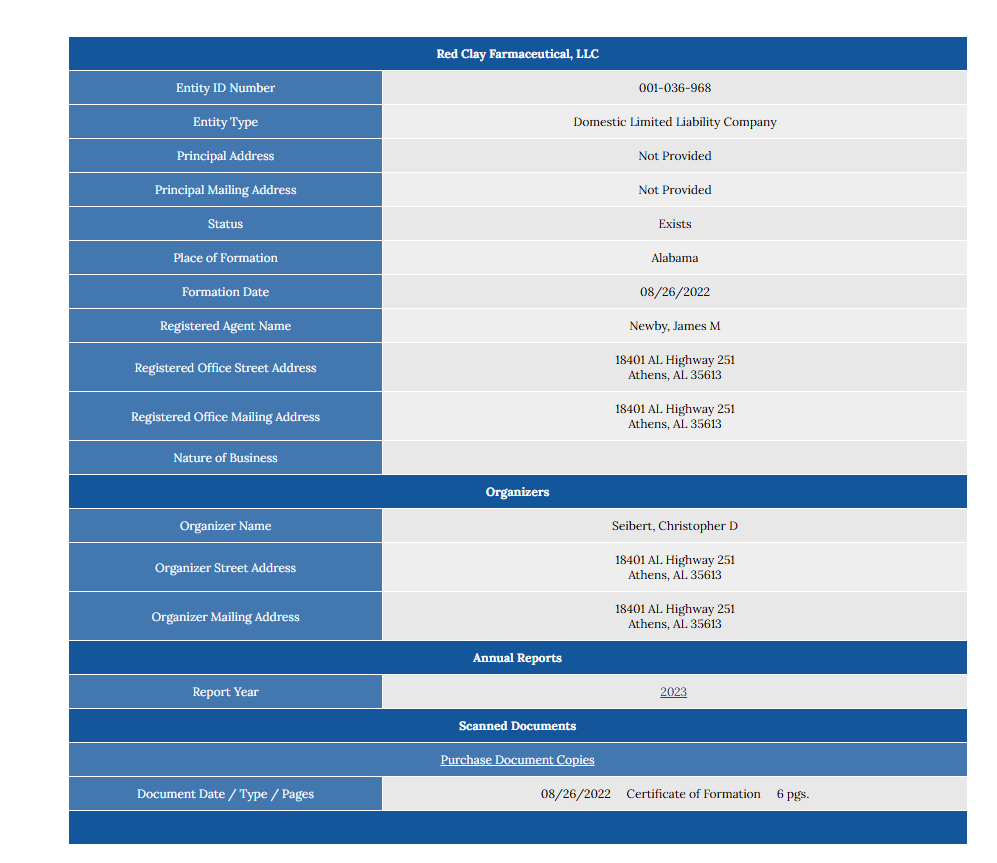
October 14, 2022 AMCC records confirm that Red Clay Farmaceutical, LLC requested business application materials from the Commission. This shows the entity was seeking entry into the state medical cannabis system months before Athens ever authorized dispensaries.
This ordinance legally enabled the future operation of dispensaries in Athens.

December 8, 2025 at a regularly scheduled Athens City Council meeting you publicly ask about potential dispensaries coming to Athens before the state had officially awarded licenses.
Council leadership including then-Council President Seibert said they had not been contacted by the state. Yet three days later on December 11, 2025, the AMCC voted to award limited dispensary licenses, including one for Athens.
This means: Athens's residents were unaware that state decisions had already been made or were about to be finalized.
The Ethics Violations in Black and White
Alabama law is unmistakably clear on public officials and conflicts of interest.
Alabama Code § 36-25-5(a)
“No public official… shall use an official position or office to obtain personal gain for himself… or any business with which the person is associated.”
Alabama Code § 36-25-9(c)
“No public official shall vote, attempt to influence, or participate in any matter in which he or she has any financial interest.”
How the Facts Fit the Law
Here’s the part that matters most to readers:
A sitting Athens City Council President created a medical cannabis-related LLC before the city ever authorized dispensary sites.
That same entity showed interest in state licensing months before the ordinance passed.
That official was presiding over the council when the ordinance was adopted, giving the gateway to dispensaries.
When repeal was later attempted, he abstained instead of recusing, effectively preserving the ordinance that makes the business viable.
The official continued participating in local regulatory preparation (such as seconding motions for medical cannabis-related staff travel).
In December 2025, the state awarded limited dispensary licenses, including one for Athens, just days after you publicly asked the council about local cannabis plans.
From a legal standpoint, that is textbook conflict of interest:
• Financial interest? Yes, the entity stands to benefit if dispensaries open.
• Official action? Yes, he presided and participated in ordinance actions that enabled the market.
• Lack of recusal? Yes, abstention does not equal recusal under the Ethics Act.
This isn’t speculation.
This is the documented interplay of private positioning and public policymaking, with no meaningful transparency to the citizens of Athens.
GP6 Was Already at the Table
Public records show that GP6 Wellness, now one of only four dispensary licensees approved statewide in December 2025, was not some last-minute entrant to the Athens market.
GP6 representatives appeared on Athens City Council agendas in November 2022, formally presenting plans to open a medical cannabis dispensary in Athens. Weeks before the ordinance authorizing dispensaries even existed.
Athens wasn’t reacting to state policy.
Athens was preparing a specific market location for a known cannabis operator.
At the very same time, a sitting City Council President had already begun positioning himself inside that market.
So What Does This Mean for Athens?
Alabama finally awarded its first limited dispensary licenses only after years of bureaucratic delay. But the state’s own FAQ makes clear:
· Dispensaries didn’t exist here until late 2025.
· Athens's residents were told the city had no state contact before licensing decisions were made.
· No physicians are yet approved to certify patients.
· Medical cannabis products are not yet available.
The legal entry point to this market was narrow and controlled. The decision to authorize local dispensaries was significant. And yet, one of the officials at the center of that decision:
· Formed a related company early
· Engaged with the state cannabis authority before public debate
· Presided over the vote that created the market
· Did not properly recuse himself despite a clear financial interest.
That pattern meets the statutory definition of an ethics violation that deserves investigation, not silence.
The Bottom Line
This isn’t a story about support for medical cannabis. This is about transparency, governance, and accountability.
When public health, city authority, and private business interests intersect, citizens deserve to know:
Who is acting in the public interest?
Who is acting for personal gain?
And where are the safeguards against conflicts of interest?
The answer in Athens so far has been murky, but the documents don’t lie.
This timeline, from LLC formation to local ordinance to state licensing, describes not just how Alabama loosened cannabis restrictions, but how an ethical line may have been crossed in the process.
And One Last Question…
City Hall would like the public to believe that someone capable of:
• Structuring a cannabis company
• Entering a restricted state licensing system
• Helping prepare Athens for dispensary placement
• And preserving the ordinance that made it all possible
…somehow didn’t know he needed a City of Athens business license.
So he knew how to set up the market.
He knew how to position inside it.
He knew how to preserve the gateway.
But not how to get a license?
Who’s really buying that?
Editor’s Note
This article is based entirely on public records, City Council minutes, Alabama Medical Cannabis Commission correspondence, and official state filings. It represents an opinion-based analysis of documented timelines and statutory ethics provisions.