

I was putting out George W. Bush signs in 2000. I worked on Bob Riley’s campaign and Arthur Orr’s first campaign in 2008. I served on both local and state Republican committees. As my family grew and responsibilities changed, I stepped away from committee work, but I never stepped away from the party I believed in. For much of my life, I have believed the Republican Party stood for accountability, fairness, transparency, and the fundamental principle that voters deserve to make informed decisions about who represents them.
That is why watching Alabama’s 2026 candidate challenges unfold has been so frustrating and, frankly, disappointing.I am not arguing that a political party should not have rules or enforce them. Rules are necessary. But those rules should be clear, consistently applied, and accessible to the very Republicans expected to follow them.
Who gets a meaningful opportunity to present a challenge? Who decides whether that challenge deserves a hearing?
Who ensures those making the decisions are free from conflicts of interest?
And perhaps most importantly, when did deciding who gets to appear on the ballot become just as consequential as allowing Republican voters to decide who should win?
After more than two decades of involvement with this party, I never imagined I would find myself asking these questions. But here we are.
Four Candidates. Different Challenges. Different Outcomes
Alabama saw multiple candidate challenges during the 2026 election cycle. For this article, I want to focus on four of the most publicly discussed cases: Jesse Battles, Angelo “Doc” Mancuso, John Wahl and Tommy Tuberville.
All four faced challenges, but the outcomes were notably different. Battles and Mancuso were removed from the Republican primary ballot following party proceedings. Both subsequently qualified to run as independents in the November 3rd general election. Meanwhile, Wahl and Tuberville remain their party’s nominees despite challenges questioning whether they satisfy Alabama’s constitutional residency requirements.
The distinction in the court cases is especially important. The Montgomery lawsuits challenging Wahl’s and Tuberville’s eligibility were dismissed on jurisdictional grounds, not because a court examined the evidence and determined that the residency allegations were unfounded. The courts did not decide the underlying constitutional residency questions in those proceedings.
These are not identical cases, and the procedural rules differ. But examining them together raises an important question: How does Alabama's Republican Party determine which challenges receive a hearing, which are dismissed on procedural grounds, and who ultimately gets to make those decisions? That is what I want readers to understand before Election Day.
Two candidates removed, despite local calls for a choice
On February 15th, the Alabama Republican Party Steering Committee removed Jesse Battles from the Republican primary ballot for Senate District 10 and Angelo “Doc” Mancuso from the primary ballot for House District 7. Both challenges were heard. Neither candidate got to compete in the Republican primary.
In Mancuso’s case, the Lawrence County Republican Executive Committee asked ALGOP to keep him on the ballot. Chairman Ken Johnson made clear that supporting his ability to run was not an endorsement. In the Battles case, the Etowah County Republican Women expressed unanimous support for rejecting the challenge. These are different organizations, but both made a distinction worth preserving: allowing voters to choose is not endorsing the candidate.
Who brought the challenges?
The paperwork filed against Mancuso identifies Matthew Green of Muscle Shoals, in Colbert County outside House District 7. A supplied state campaign-finance screenshot lists a Matthew Green of Muscle Shoals contributing $250 to incumbent Ernie Yarbrough, Mancuso’s opponent, in July 2025. The matching name and hometown suggest a connection.

Campaign-finance row showing a $250 contribution from Matthew Green of Muscle Shoals to Ernie Yarbrough.
The challenge against Battles came from Julia Nolen Cleland, whose filing listed Jefferson County also outside Senate District 10. On August 23, 2025, Cleland publicly shared a post encouraging support for Amy Dozier Minton, another Republican in that same Senate race.
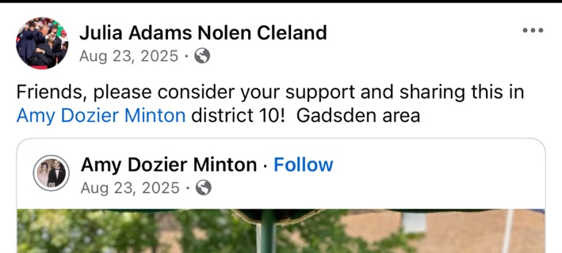
Aug. 23, 2025, public Facebook post encouraging support for Amy Dozier Minton.
None of that proves a challenge was improper. A person’s support for one candidate does not automatically prevent them from challenging another, and living outside a district may be permitted by party rules. But it is reasonable to ask what safeguards exist, who screened the complaints, and whether relevant relationships were considered.
The residency challenges received different treatment
In February, the initial challenges questioning John Wahl’s and Tommy Tuberville’s residency qualifications did not advance to the formal hearings held for Battles and Mancuso. The cases were not identical: eligibility provisions, party bylaws and procedural requirements can differ. In June, a later Tuberville challenge did receive a hearing and was rejected. But why did the party deem some filings worthy of hearings and not others? The public deserves a clear explanation of the standards and any required recusals.
I know how difficult this process can be, I tried to navigate it
I learned about that process firsthand. I filed a June election contest concerning John Wahl’s nomination. I drove to Birmingham to deliver the paperwork at ALGOP headquarters in person. What sounded like a straightforward filing quickly became a scramble to satisfy requirements that, in our experience, were far from obvious.
I arrived first thing that morning without realizing a $50 filing fee was required. We then had to arrange to get that payment back to headquarters before the 1:00 p.m. deadline. Then-Chief of Staff Shannon Whitt warned that missing the cutoff would mean the filing was thrown out. That urgency was frustrating because I had already been there that morning and, as I recall, had not been warned about the fee when I initially delivered the documents. The need to handle it in person added another obstacle.
I can almost laugh at how absurd the back-and-forth felt now. I was not laughing that day. To me, the process seemed written for people who already knew every procedural detail, or had an attorney to navigate it for them. Ordinary Republicans seeking answers should not have to learn filing rules through trial and error on the day of a deadline.
ALGOP dismissed my contest without a hearing, citing failure to satisfy election-law requirements. We were told that not specifying the last election in which I voted was part of the problem. The party’s public explanation described the filing as legally insufficient without identifying that particular detail. That is an important distinction: the dismissal did not amount to a hearing on the underlying residency allegations. A technical defect and a finding on the merits are not the same thing.
A seven-year penalty for suing the party and losing?
Then, at ALGOP’s August 1st summer meeting, State Auditor Andrew Sorrell, who chaired the party’s Bylaws Committee, proposed a rule that went much further than ordinary filing requirements. As reported by the Alabama Reflector, the proposed change would have barred someone from running on the Republican ballot for seven years after bringing legal action against ALGOP, its state executive committee or local committees unless that person succeeded on every claim. It was directed at litigation against the party, not routine candidate-challenge filings. But consider the consequence: a person could raise a genuine legal dispute, prevail on some points, lose another, and still face a seven-year ballot-access penalty under the proposal as reported.
Sorrell defended the idea by saying that litigation over Tommy Tuberville’s eligibility had cost the party nearly $50,000, money he believed should have supported Republican campaigns. Party litigation costs are a legitimate concern. Yet the proposed test was not simply whether a judge had found a lawsuit frivolous. It turned on whether the challenger won on every count. Those are two very different standards. A case can be dismissed for standing, a deadline or another procedural issue without a court ever deciding the underlying dispute. We had just experienced how much a procedural rejection could overshadow the substance of a challenge.
Republicans inside the meeting challenged the proposed restriction. Sen. Sam Givhan warned that a person can lose an honest, legitimate lawsuit without having filed a frivolous one. William Rayburn of Crenshaw County argued that the rule could silence dissent. Suzelle Josie of Autauga County cautioned against handing party leadership a power that might be difficult to take back. Approximately 58% of the State Executive Committee voted to indefinitely postpone the amendment. It did not become a party rule. To me, that vote was an important reminder that Republicans can question their own leadership and reject a proposal they believe goes too far.
But I cannot ignore the message the proposal might have sent had it passed: challenge party leadership in court, fail to win every argument, and risk losing the chance to seek office as a Republican for seven years. How does that encourage accountability? How does it square with the principle that disagreements should be resolved through evidence, fair hearings and transparent rules? Party officials have a right to defend against litigation; members also have a right to question whether party procedures leave room for good-faith dissent.
This is not the Republican Party I remember
I have been a Republican for as long as I can remember. I have campaigned, served on committees and believed that people could disagree on real issues without having their loyalty questioned. I have now seen the challenge process from the other side of the counter. What stays with me is not just the paperwork or the drive to Birmingham. It is how easily a serious question can become a dispute over whether an ordinary person checked the correct box.
I am not asking anyone to support Jesse Battles, Angelo Mancuso, John Wahl, Tommy Tuberville or their opponents. I am asking ALGOP to publish clear requirements, explain why some cases received hearings while others did not, and disclose how its recusal and conflict rules were applied. Republican voters should be able to understand the process without inside knowledge.
This is not what I knew our party to be. Something has to give. Alabamians, before November 3rd, please do your own research. Read the documents. Ask questions about every candidate. And remember being allowed to ask those questions matters, no matter whose name is on the ballot.