

The Funding Question No One Wants to Answer:
How Alabama Connections Academy’s Enrollment Drives Limestone County Funding and Where the Money Goes
Alabama Connections Academy is listed as a public school based in Athens, Alabama, but it operates as a fully virtual statewide program serving more than 7,200 K through 12 students. State data shows only 8 percent of students are proficient in math and 42 percent in reading, with 68 percent classified as economically disadvantaged. While it appears to be just another local school on paper, these students are still counted under Limestone County Schools’ enrollment totals, which directly impacts how much state education funding the system receives. Making this not just a virtual learning story, but a local funding one.
For years, Limestone County Schools (LCS) has benefited from hosting Alabama Connections Academy (ALCA), a statewide, for-profit virtual public school. On paper, the arrangement looks simple: Limestone serves as the Local Education Agency (LEA), and the state funds follow the students.
But when the funding documents are examined together including federal court records, Limestone County budget attachments, and the ALCA Foundation Program allocation, a much more complicated and troubling picture emerges.
This is not about school choice. This is about public money, headcounts, and line items that don’t match reality.
Attachment 1: The Sisk Plea Agreement and Why This Context Matters
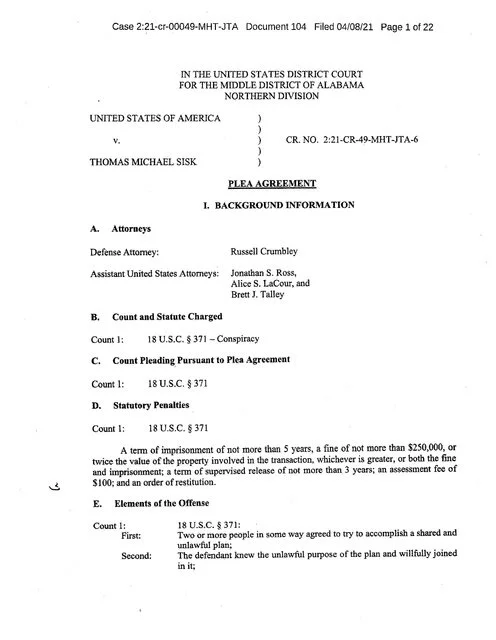
In United States v. Thomas Michael Sisk (Middle District of Alabama), the federal government outlined how education funding mechanisms can be manipulated through enrollment counts and internal allocations. While this case is separate from Limestone County, it establishes a critical baseline:
Federal and state education dollars are vulnerable when oversight relies on reported figures rather than real-world services delivered.
That context matters because Limestone County’s Foundation Program funding is explicitly driven by headcount (ADM), not by services actually provided.
Attachment 2: Limestone County Foundation Program Funding
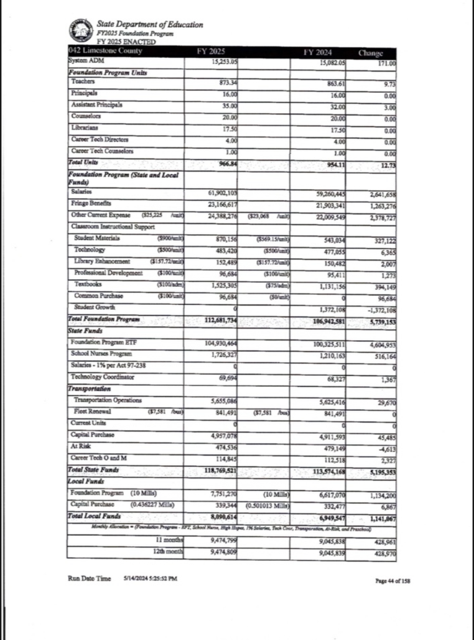
The Alabama Foundation Program is the primary, resource-based funding formula used to provide basic state education funding to local school systems, largely determining personnel costs. Operating since the mid-1990s, it has historically provided roughly $7,000 per student, though it is currently under review for modernization to better address evolving needs.
The Limestone County Schools budget (FY 2024–2025) shows significant increases across nearly every Foundation Program category:
· Teachers
· Buses & fleet renewal
· Nurses
· Librarians
· Textbooks
· Technology
· Classroom instructional support
· Fringe benefits
These increases are justified through earned units, which are calculated using Average Daily Membership (ADM) student headcount.
Key point: ALCA students count as Limestone County students for funding purposes.
That means every ALCA student:
· Qualifies Limestone County for more teachers
· Qualifies the district for more buses
· Increases nurse, librarian, and textbook allocations
· Generates millions in fringe benefit funding
Attachment 3: Alabama Connections Academy Funding Allocation
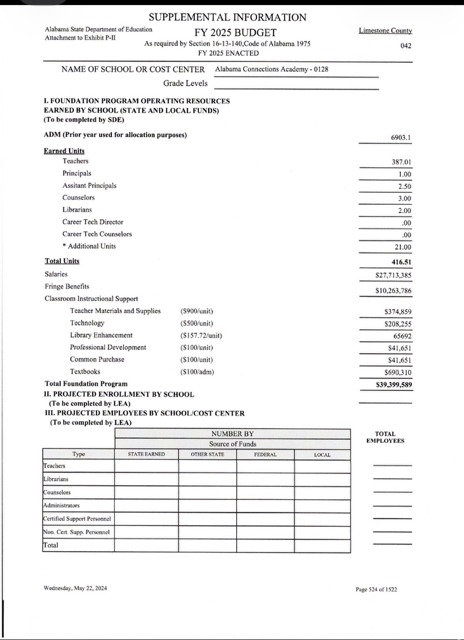
ALCA’s own FY 2025 budget document tells a very different story.
ALCA Earned Units (ADM: 6,903.1 students)
ALCA generated funding for:
· 387 teachers
· 1 principal
· 2.5 assistant principals
· 3 counselors
· 2 librarians
· 21 additional units
Total Foundation Program Funding:
$39,399,589
This includes:
· $27.7 million in salaries
· $10.2 million in fringe benefits
· Classroom instructional support
· Technology
· Textbooks
· Professional development
· Common purchases
The Contract Clause That Changes Everything
The original ALCA contract contains a critical provision:
“ALCA employees will not participate in the district fringe benefit program.”
This raises an unavoidable question:
If ALCA employees do not receive Limestone County fringe benefits,
Why did Limestone County receive over $10 million in fringe benefit funding tied to ALCA headcount?
And more importantly:
Where did that money go?
Services ALCA Does Not Provide:
· Has no buses
· Has no fleet
· Has no school nurses
· Has no libraries
· Does not purchase district textbooks
· Uses a proprietary curriculum
· Issues ALCA-owned computers
· Employs non-district teachers
Yet Limestone County receives funding for:
· Transportation operations
· Fleet renewal
· Nurses
· Library enhancement
· Common purchases
· Textbooks
· Technology
· Instructional support
· Fringe benefits
The Central Question: Line Items Without Services
When funding is allocated for services that are never delivered, one of three things must be true:
1. The money was reallocated internally
2. The money was absorbed into the general fund
3. The money was used to offset other district expenses
What is missing is transparency.
There is no clear line item showing:
· Fringe benefits being returned to the state
· Transportation funds being removed
· Nurse allocations being reduced
· Library funding being adjusted
· Textbook purchases being excluded
Instead, totals increase year over year.
The Compounding Effect (2017–Present)
These numbers are not isolated to one year.
ALCA has operated since 2017, with enrollment increasing significantly over time. Even at lower enrollment levels early on, the funding impact compounds annually.
Over nine years, this likely represents:
· Tens of millions of dollars
· Allocated based on headcount
· For services ALCA students never receive
· This Is Not an ALCA Parent Issue
· Parents choosing virtual education are not the problem.
This is a structural funding issue:
· Limestone County hosts a statewide virtual school
· Headcount inflates earned units
· Funding follows formulas
· Oversight relies on assumptions, not audits
The remaining issue is transparency. Several basic questions still need clear answers. The public has not been shown where the fringe benefit funding connected to Alabama Connections Academy enrollment was ultimately allocated, or whether any specific budget line items were adjusted to account for the virtual program. It is also unclear whether transportation, nursing, and library funding was reallocated or retained despite those services not being used by virtual students. Another important question is whether state officials were notified that Alabama Connections Academy employees do not participate in the district benefit system. There has also been no publicly identified independent audit comparing the reported student headcount to the services actually provided. As enrollment continues to drive funding totals upward, residents are asking why overall Limestone County funding increases while the virtual school operates outside the district physical infrastructure.
Bottom Line
This is about public dollars, public records, and public accountability.
When funding formulas reward headcount without verifying services, transparency is not optional, it is essential.
And right now, the numbers do not explain themselves.
Editor’s Note
This article reviews publicly available records, including education funding documents, budget attachments, and contract language. It does not accuse any parent, student, or individual employee of wrongdoing.
The Limestone Lowdown is examining how funding formulas and enrollment counts affect public education dollars and whether those allocations are clearly explained to taxpayers. Our goal is transparency and accuracy. If additional documentation provides clarification, we will review it and update accordingly.